
Horizontal Directional Drilling

Horizontal Directional Drilling in Windsor
Horizontal Directional Drilling (HDD), sometimes called Trenchless Installation, is the process of using a surface launched, steerable drill head to bore a pilot hole in the ground for the instillation of a large variety of services such as Water Services, gas lines, electrical conduit, fiber lines and more.
A pair of skilled technicians navigate the drill through the ground beneath the surface desired to remain undisturbed. The disruption of surfaces such as driveways, roadways, parking lots, grasslands, and even waterways can be costly and impactful. Even with the most skilled restoration, there is typically a visible seam in the repaired solid surface. HDD prevents this blemish by installing the service below the surface, without requiring a trench to be cut. Another advantage to Trenchless Instilation is the ability to weave over and under existing services to maintain grade. This eliminates the need for additional connections ensuring a stronger infrastructure.
Prior to the operation, a survey is conducted to determine safe locations to enter and exit the ground. Utilities are identified and located. Buried services are exposed with a Hydro-Vac through a process known as ‘daylighting’. This is done to ensure the safe passage of the instruments and attachments of the HDD. Highly sophisticated instruments tell the operators every detail of the equipment in real time. Information including depth, distance, angle of pitch, angle of rotation, temperature, pressure, force, thrust, drag, etc. The technicians use this data to make informed decisions to pilot the drill on its intended course. Although this information is impressively accurate, daylights are used, not only to verify the clearance of utilities, but also to provide ‘relief’ holes.
Relief holes afford the opportunity to verify the calibrations of the equipment and, as the name suggests, provide relief for the mud that is created during the HDD process. Fluids are pumped through the nozzle of the drill head. This is used to break up the media in which the drill is traveling. It is also used to prevent the tooling from overheating. Furthermore, the slurry created helps to lubricate the material that is to be installed during ‘pull back’.
The Operator mans the drill with the aid of The Locator. Both play their own crucial role in the process. The team first walks the path of the ‘shot’ to formulate an understanding of the obstacles, conditions, and identify landmarks to reference. While in radio contact, The Locator uses a tracking/targeting system to guide The Operator. The Locator literally places a digital target in the ground. The locator can control the depth of the target, along with the angle and swivel degree. The Operator receives the target on the display of the drill and steers the drill head towards the target.

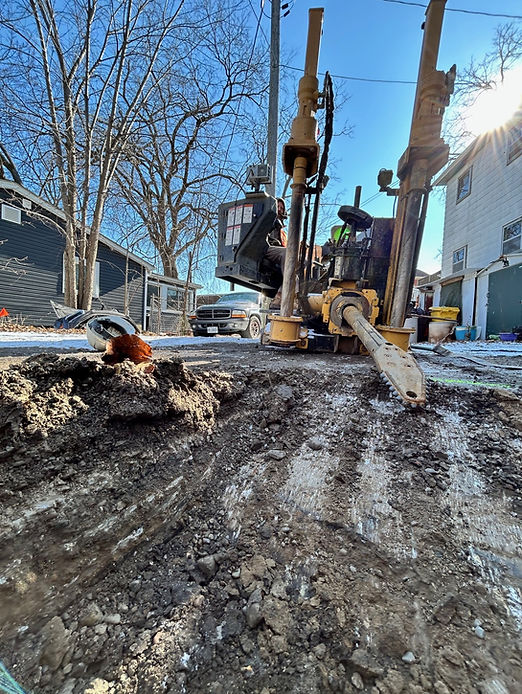
The drill contains of a powerful hydraulic motor that pushes the head into the ground with the aid of the drilling mixture to break apart the ground. The drill is specifically shaped to allow steering. There is an angled ‘duck bill’ that is orientated by The Operator. The high-pressure water breaks up the media askew from center. When the tool is thrust forward, it veers from center in the intended direction. The selected time, as the hour hand of an analog clock, is what steers the drill in its prescribed direction. The drill head transmits its data to The Operator, and they control the direction of the shot.
The initial drill shot often creates a sufficient pilot hole for the service to be installed. The head of the drill bores a clearance hole for easy instillation of services such as gas, hydro conduit, water service etc. up to 4” in diameter with no additional tooling in many circumstances. If larger material is required to be pulled, a reamer can be installed on the drill head to enlarge the hole further.
Mud is churned by large carbide teeth to create a slurry that flows out of the hole and is often removed via Hydro-vac. The requested material is connected to the drill head and pulled back through the bore hole while the pressures and forces are monitored by The Operator who can control the flow of water as necessary.
There are times where minimal intrusion is required during the process for daylights or of course connection to an existing main. Though surface restoration will sometimes be required, the scale and masking of these areas is significantly minimized with the aid of Horizontal Directional Drilling.
